
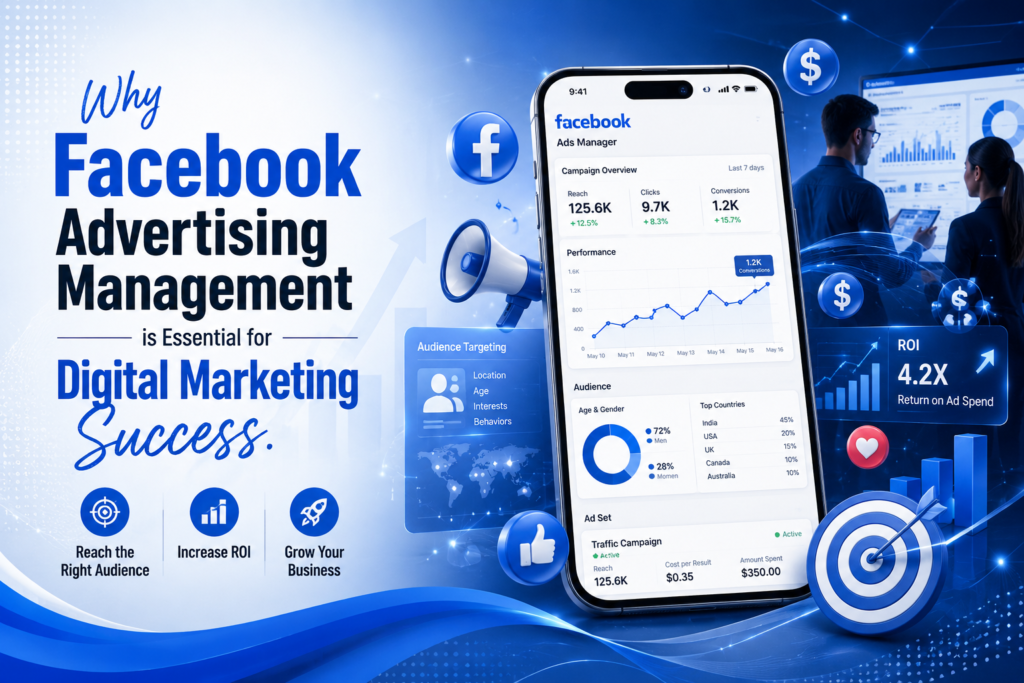
In the ever-evolving digital landscape, businesses must continuously adapt to new technologies and marketing strategies to stay competitive. One of the most powerful tools that has transformed the way brands connect with their audience is Facebook advertising. With billions of active users worldwide, Facebook offers unmatched opportunities for businesses to reach, engage, and convert potential customers.
However, simply running ads is not enough. Success lies in effective Facebook Advertising Management—a strategic approach that ensures your campaigns are optimized, targeted, and delivering measurable results. Whether you are a startup, a growing business, or a freelance digital marketer, understanding the importance of managing Facebook ads properly can significantly impact your overall digital marketing success.
Understanding Facebook Advertising Management
Facebook Advertising Management refers to the process of planning, creating, executing, monitoring, and optimizing ad campaigns on Facebook. It is not just about setting up ads; it involves a comprehensive strategy that aligns with your business goals.
This process includes:
- Identifying target audiences
- Designing compelling ad creatives
- Setting budgets and bidding strategies
- Tracking performance metrics
- Continuously optimizing campaigns
A well-managed Facebook advertising campaign ensures that every rupee spent contributes toward achieving meaningful business outcomes, such as increased brand awareness, lead generation, or sales conversions.
The Role of Facebook in Digital Marketing
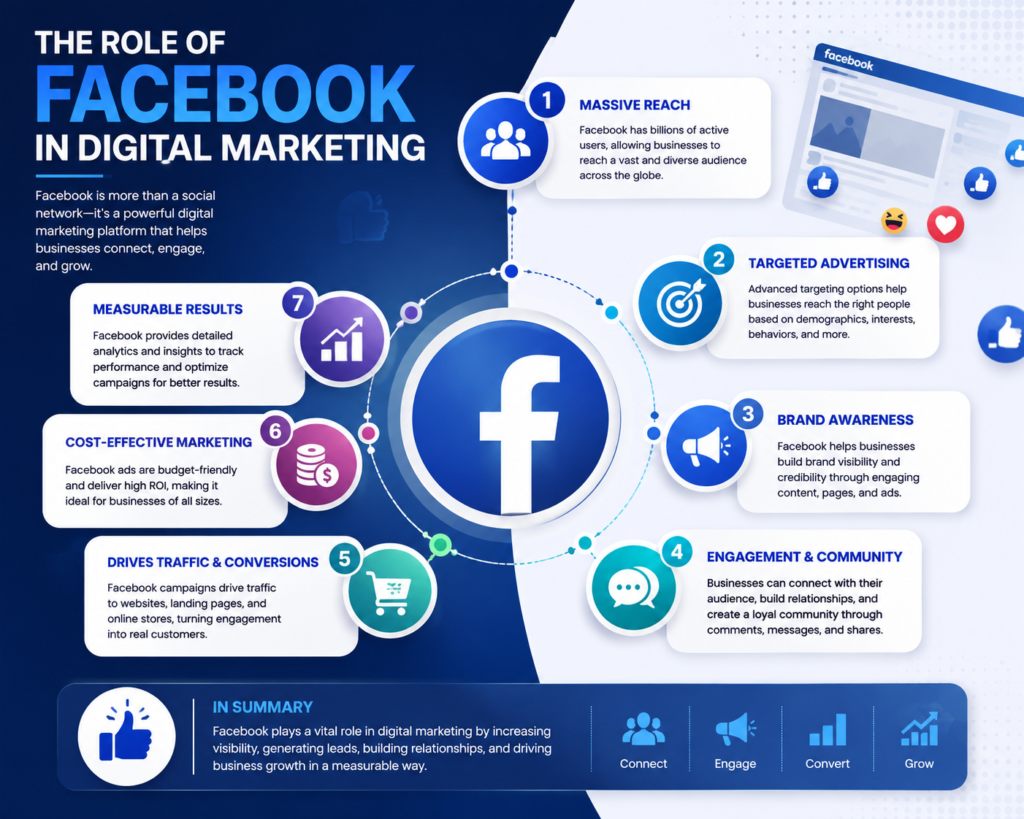
Facebook continues to be one of the most powerful platforms in the digital marketing landscape.Its extensive user base and advanced targeting options make it a preferred choice for marketers across industries.
Unlike traditional advertising methods, Facebook allows businesses to interact directly with their audience. It bridges the gap between brands and consumers by enabling real-time engagement, personalized messaging, and data-driven decision-making.
With proper Facebook Advertising Management, businesses can:
- Reach global and local audiences
- Build strong customer relationships
- Increase visibility and credibility
- Generate consistent leads and sales
Why Facebook Advertising Management is Essential
1. Advanced Audience Targeting
One of the biggest advantages of Facebook advertising is its highly detailed targeting capabilities. Businesses can pinpoint their ideal audience by evaluating consumer behavior, demographics, and interests.
- Demographics (age, gender, education)
- Geographic location
- Interests and hobbies
- Online behavior and purchase patterns
Effective Facebook Advertising Management ensures that your ads are shown only to the most relevant audience. Cuts down on excess costs and improves the likelihood of successful conversions.
For example, a local business in Kerala can target users in specific cities like Malappuram, ensuring that ads reach people who are more likely to become customers.
2. Cost Efficiency and Budget Control
Facebook advertising is flexible and scalable. Getting started is possible without major expenses. Even with a small investment, businesses can achieve impressive results if campaigns are managed correctly.
Proper Facebook Advertising Management helps:
- Allocate budget wisely
- Avoid unnecessary spending
- Optimize cost per click (CPC)
- Improve return on investment (ROI)
By analyzing performance data, marketers can shift budgets to high-performing ads and pause underperforming ones.
3. Increased Brand Awareness
Consistency plays a vital role in creating a powerful and recognizable brand identity. Facebook ads help businesses stay visible to their target audience through repeated exposure.
With effective Facebook Advertising Management, brands can:
- Maintain a consistent online presence
- Build recognition and trust
- Stay top-of-mind among customers
Even if users do not make an immediate purchase, they are more likely to remember your brand when they need your product or service.
4. Higher Engagement Rates
Facebook is designed for interaction. Users can like, comment, share, and engage with content easily. This makes it an ideal platform for building relationships with your audience.Well-managed campaigns focus on creating engaging content that encourages interaction. High engagement signals also improve ad performance, making campaigns more effective.
5. Improved Conversion Rates
The ultimate goal of any marketing campaign is conversion—turning potential customers into actual buyers. Facebook ads are highly effective in driving conversions when managed properly.
Through Facebook Advertising Management, businesses can:
- Use retargeting strategies
- Create personalized ads
- Optimize landing pages
- Improve customer journey
By targeting users who have already shown interest in your brand, conversion rates can increase significantly.
6. Data-Driven Decision Making
One of the strongest advantages of Facebook advertising is its detailed analytics and reporting tools. Marketers can track:
- Impressions
- Click-through rates (CTR)
- Conversion rates
- Engagement metrics
Effective Facebook Advertising Management involves analyzing this data regularly and making informed decisions. This ensures continuous improvement and better campaign performance over time.
Key Components of Successful Facebook Advertising Management
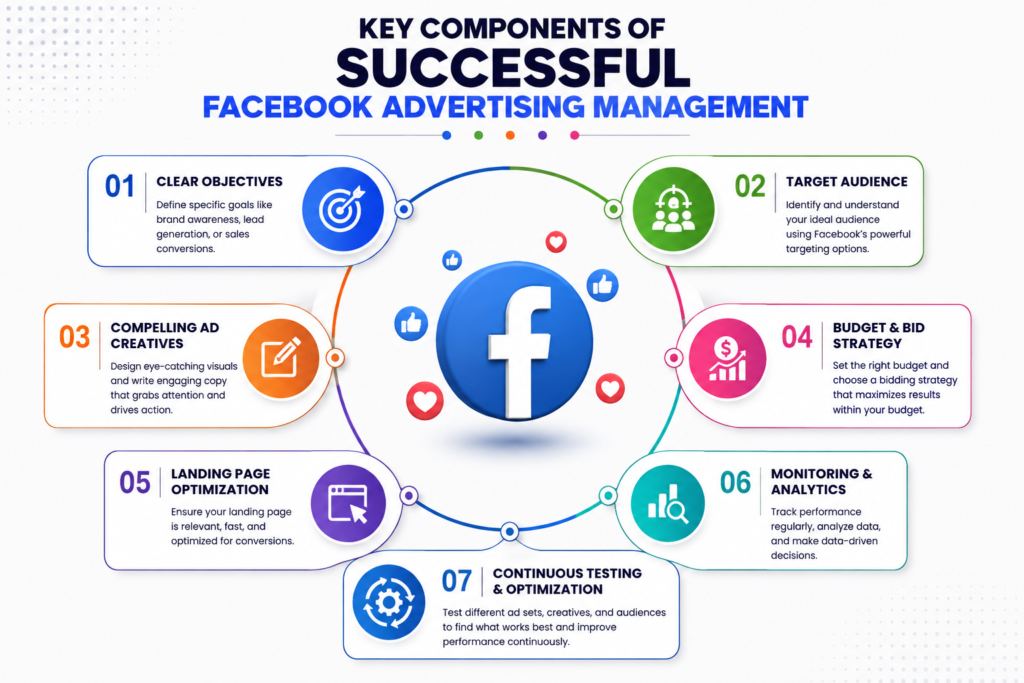
1. Clear Campaign Objectives
Before launching any campaign, it is important to define clear goals. Facebook provides various campaign objectives, such as:
- Brand awareness
- Traffic
- Engagement
- Lead generation
- Conversions
Choosing the right objective ensures that your campaign is aligned with your business goals.
2. Audience Research and Segmentation
Understanding your audience is crucial. Divide your audience into segments based on their preferences and behavior. This improves your ability to produce targeted and high-performing campaigns.
What is Audience Research?
Audience research means understanding who your potential customers are. Instead of showing ads to everyone, you study your audience to learn:
- Their age, gender, and location
- Their interests and hobbies
- Their online behavior (what they like, click, or buy)
- Their needs and problems
Example:
If you are a freelance digital marketer, your audience might be:
- Small business owners
- Startup founders
- Local shop owners in Kerala
What is Audience Segmentation?
Segmentation means dividing your audience into smaller groups based on similar characteristics.
Instead of one general ad, you create different ads for different groups.
Types of Segmentation:
- Demographic Segmentation
- Age, gender, income, education
Example: Ads for young entrepreneurs (age 20–30)
- Age, gender, income, education
- Geographic Segmentation
- Location (city, country)
Example: Target businesses in Malappuram or Kerala
- Location (city, country)
- Behavioral Segmentation
- Buying behavior, website visits, engagement
Example: People who clicked your website before
- Buying behavior, website visits, engagement
- Interest-Based Segmentation
- Hobbies, interests, preferences
Example: People interested in digital marketing or business growth
- Hobbies, interests, preferences
Why is it Important?
- Better targeting – Your ads reach the right people
- Higher engagement – People relate more to your message
- More conversions – Increased chances of getting clients
- Cost-effective – You don’t waste money on the wrong audience
Simple Example
Instead of one ad saying:
“I offer digital marketing services”
You can create:
- Ad 1:Elevate your business with powerful digital marketing techniques
Ad 2: “Get more online sales for your eCommerce store” (for online sellers)
Each group gets a custom message, which works better.
3. High-Quality Ad Creatives
Visual content plays a major role in capturing attention. Use:
- Eye-catching images
- Engaging videos
- Clear and concise text
A strong creative can significantly improve the performance of your ads.
4. Compelling Ad Copy
Your message should be clear, persuasive, and action-oriented. A good ad copy includes:
- A strong headline
- Clear value proposition
- Call-to-action (CTA)
5. A/B Testing
Testing different versions of ads helps identify what works best. Experiment with:
- Headlines
- Images
- Audience groups
- Ad placements
Continuous testing is a key part of effective Facebook Advertising Management.
6. Performance Monitoring and Optimization
Regular monitoring allows you to identify issues and improve results. Optimize campaigns by:
- Adjusting targeting
- Modifying creatives
- Reallocating budget
Advanced Strategies for Facebook Advertising Management
1. Retargeting Campaigns
Retargeting allows you to reach users who have already interacted with your brand. Elevate your business with powerful digital marketing techniques
2. Lookalike Audiences
Facebook can create audiences similar to your existing customers. This expands your exposure while maintaining a strong connection to your audience.
3. Funnel-Based Advertising
A successful strategy involves targeting users at different stages:
- Awareness stage
- Consideration stage
- Decision stage
Each stage requires a different type of content and messaging.
4. Mobile Optimization
A significant number of users rely on mobile devices to use Facebook. Ensure that your ads and landing pages are mobile-friendly.
5. Video Marketing
Video content is highly engaging and can deliver better results compared to static images. Short, informative videos can capture attention quickly.
Common Challenges in Facebook Advertising Management
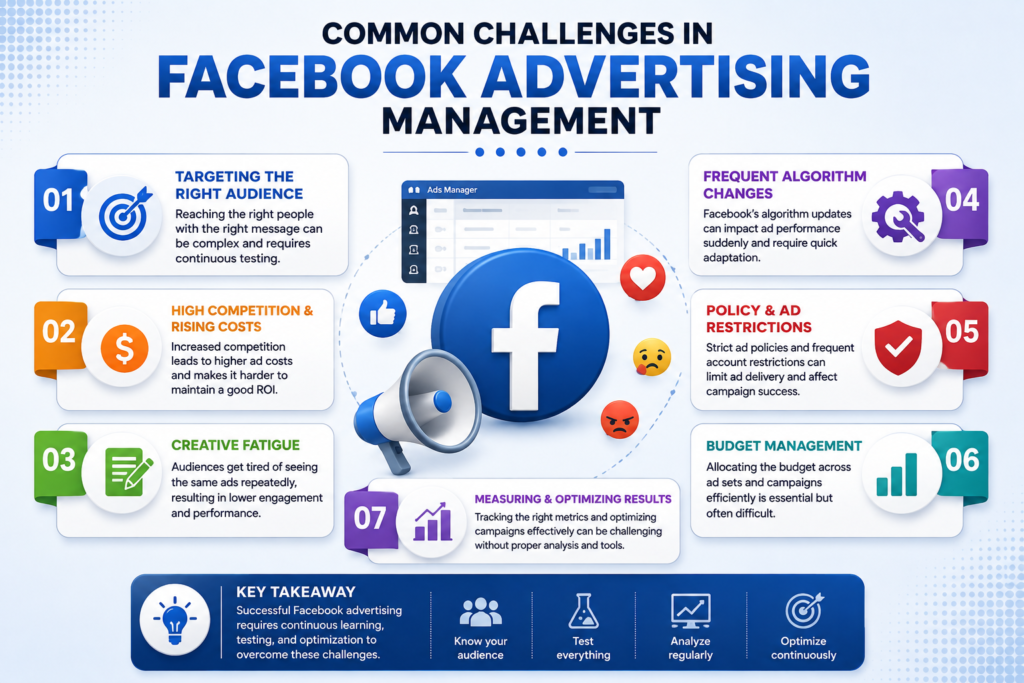
Despite its advantages, Facebook advertising comes with challenges:
- Increasing competition
- Changing algorithms
- Ad fatigue
- Audience saturation
Effective management helps overcome these challenges by adapting strategies and staying updated with trends.
Mistakes to Avoid
To achieve success, avoid these common mistakes:
- Not defining clear goals
- Ignoring data and analytics
- Using poor-quality visuals
- Targeting the wrong audience
- Failing to test and optimize
Avoiding these errors can significantly improve your campaign performance.
The Future of Facebook Advertising Management
The future of Facebook advertising is driven by technology and innovation. Trends to watch include:
- Artificial intelligence and automation
- Personalized advertising
- Video-first strategies
- Privacy-focused marketing
Businesses that adapt to these trends and invest in effective Facebook Advertising Management will have a competitive advantage.
Conclusion
In today’s competitive digital environment, businesses cannot afford to ignore the power of Facebook advertising. However, success is not just about running ads—it is about managing them effectively.
Facebook Advertising Management plays a crucial role in ensuring that your campaigns are targeted, optimized, and delivering results. From audience targeting and budget control to performance tracking and optimization, every aspect contributes to achieving digital marketing success.
By mastering Facebook advertising management, businesses can increase brand visibility, generate quality leads, and drive higher conversions. Whether you are a beginner or an experienced marketer, investing time in learning and implementing effective strategies will help you unlock the full potential of Facebook advertising.